Review

There is in this world a kind of desire like a stinging pain
SPOILERS!
A preface: I know, I know, I know. Mishima was a fascist, and that stuff is bad. He disembowelled himself after a failed 1970s military coup. This is a semi-autobiographical book, written two decades earlier. It delineates his life through 1930’s Japan: he spends a weak boyhood in his grandmother’s sickroom, before graduating to the masculine and draft-dodges as the war ran down to surrender. None of this context is exculpatory; it wasn’t exactly written by someone who believed in the need to make excuses, but it does take you to the extremes of human honesty about aesthetics, discipline, and shame.
It follows the coming-of-age of a Mishima stand-in, Kochan. As a young boy, Kochan realises that he’s attracted to men dying honourable and violent deaths.
There is no virtue in curiosity. In fact, it might even be the most immoral desire a man can possess.
Central to this is Guido Reni’s Saint Sebastian:
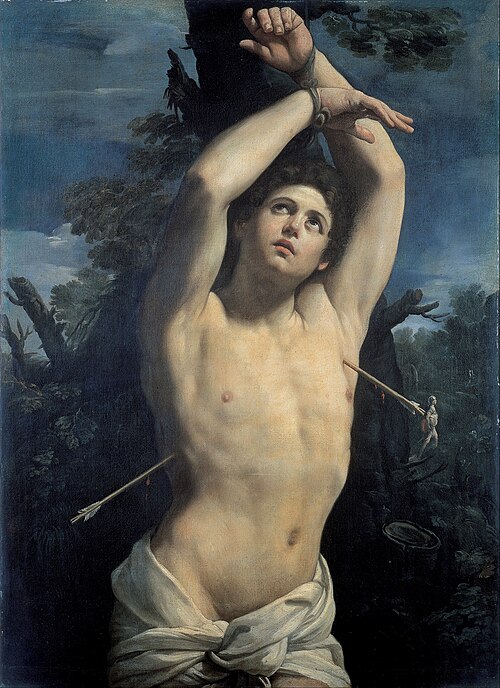
He feels guilty and isolated from everyone else. As the war progresses, he struggles with his own physicality. He’s a sickly boy. In contrast are his two first loves: the night-soil man and Saint Sebastian. The shit collector and a beautiful man pierced by arrows are bodies in degradation. His first schoolboy infatuation, Omi, ends in discovering the envy wrangled into this whole situation.
As part of my system of self-discipline, dating from childhood, I constantly told myself it would be better to die than become a lukewarm person, an unmanly person, a person who does not clearly know his likes and dislikes, a person who wants only to be loved without knowing how to love
Playing up his frailty, he avoids seeing any military action during the war. Instead, he’s stuck doing administrative work for he-man military men. During this episode, he almost marries a woman called Sonoko, but panics and backs out of an engagement. Sonoko is treated like an object of experimentation. He hopes to use her to see if normalcy can be achieved, and quickly falls into a depression when he fails. It’s hard to tell whether the narrator feels any remorse over this. The mask he wears is also an avoidance of guilt.
Sonoko ends up marrying another man. The book closes with them having a dance, and he begins to feel some peace before getting distracted by a man and fantasising about plunging a dagger through his belly.
I had forgotten Sonoko’s existence. I was thiking of but one thing: Of his going out onto the streets of high summer just as he was, half naked, and getting into a fight with a rival gang. Of a sharp dagger cutting through his belly-band
Twenty-one years later Mishima committed seppuku in the same way after a failed coup.
Bigger Ideas
The book deals with themes of choice and desire. He feels condemned to this life but also feels as if he’s put himself in this position. He blames his younger self for beginning this “dirty habit”. There’s a real openness to whether he ever had a choice at all: how much of our adult selves is just the residue of things we stumbled into as children?
It’s also about a man entrapped by shame and by his own behaviour: should he accept himself, or fix himself? I’ve read other books that answer cleanly “just accept yourself,” with the shame reframed as coming from a society we now see as regressive. Confessions of a Mask refuses that comfort. Many will find themselves quietly begging the narrator to just please conform: just marry Sonoko! Please don’t kill any men!. It feels wrong and almost dangerous for a man drawn to this kind of violence not to suffer for it. So what is he to do?
I had my first Mishima experience with “Beautiful Star,” and it was disappointing: a lot of rambling, trying to get at something without ever quite landing it. I gave him a second chance with Confessions of a Mask. It was still a slog, but an emotional and heavy one — and a good reminder of what fiction is actually for. It doesn’t answer the Big Questions it raises; Mishima never tells you whether Kochan should have accepted himself or fought himself; It hands you a life and a set of instincts entirely unlike your own, and asks you to sit inside them and to please feel some empathy. How else could I, a left-winger in a Western country with no murderous tendencies, find so much emotional overlap in a story about a homicidal post-war Japanese fascist?